

During The Pirate Bay trial, the music industry placed the blame for the decline in their revenues squarely on the shoulders of file-sharers. Their logic is clearly flawed, but it could sway the verdict if no alternative explanation is presented. So, if piracy isn’t to blame, then what is *actually* killing the music industry?
Written by: Jens Roland Via: TorrentFreak
Jens Roland is a computer scientist by training, but a technology forecaster by trade. He has worked at international think tanks as a consultant and researcher in emerging technologies and has written more than 300 articles and a book on the subject.
According to Per Sundin, CEO of Universal Music, the decline in music revenues in the past 8 years can be fully attributed to (read: blamed on) illegal file sharing. If this were actually true, many of us might even respect his decision to go after pirates as fiercely as the music industry is doing right now. However, the past 8 years have seen a lot more changes in the landscape of home entertainment than Per Sundin would like to admit, and some of those changes have had a massive impact on music profitability — much more so than any amount of piracy.
Let us refresh our memories and take a look at what actually happened during and just before the past 8 years:
1. First, the explosive rise of computer and console gaming. This competitive ‘third element’ has appeared in the entertainment landscape, beaten both music and movies to the curb and taken a huge cut out of the music industry’s revenues. Consumers don’t have infinitely-deep pockets, and billions of ‘recreation dollars’ that used to go almost exclusively to music, are now going into gaming.
2. International trade agreements have allowed consumers to buy their music across borders, rather than accepting local prices on music based on the ‘relative wealth’ of nations, rather than the actual value of the product.
3. New forms of distributable media, most notably MP3s but also CDs, have become mainstream. These new media don’t degrade over time and rarely break at all, making music rebuys a thing of the past, and allowing the second-hand market for music to thrive and expand - both of which take a cut out of the music industry’s former revenues.
4. Radical technological innovation has taken place in the field of music creation, processing, mixing, and mastering. Recording hardware, CD burners, music software, and media encoders have evolved to the point where most artists can actually afford decent-quality equipment to do their own recording and producing. Furthermore, this has fostered literally thousands of smaller, specialized studios that are challenging the ‘Big 4′ with lower prices, better terms for artists, genre-specific expertise, etc. Successful artists can now leave the big labels and start their own recording outfits on relatively modest budgets. Naturally, super stars like The Beatles or Frank Sinatra have always had this option, but the recent technological advances have lowered the bar drastically. This development is depriving the ‘Big 4′ of many of their former cash cows, who now use the major labels for their advertising and distribution infrastructure alone.
5. The World Wide Web has become an omnipresent force in the world, allowing cheap, end-to-end distribution of digital music, increasingly cutting out the corporate music distributors, who deal in trucks and CD covers, rather than bytes and bandwidth. With iTunes leading the way (very successfully ‘competing with free’, I might add), billions of songs are now purchased digitally rather than physically, no longer necessitating the big labels’ distribution networks.
6. The total number of radio stations, music television networks and other ’streaming’ sources of music has grown exponentially, giving music fans a huge selection of free (and legal) music options. Satellite radio, DAB, and internet radio broadcasts have made it trivial for consumers to simply tune into a channel broadcasting the exact sub-genre of music that they feel like listening to (they can even have a stream created for them dynamically, e.g. on Pandora), making the *purchase* of music entirely optional for the casual listener.
7. A massive selection of entertainment alternatives (home computing, console gaming, mobile devices, etc.) have appeared in the home, effectively marginalizing music as an activity. 15-20 years ago, youths would regularly visit each other just to listen to music together; today, that is virtually unthinkable without some form of activity involved, such as playing Guitar Hero or Rock Band, or dancing at a concert.
8. And finally, the music industry itself has embraced the opportunities of digital media, at last letting consumers buy *single* tracks at a time rather than forcing entire albums full of ‘fillers’ on them. Looking at the RIAA’s own sales figures for the past 10 years, there is a *direct* correlation between the break-off in album sales and the introduction and increase in single track digital sales. Looking at the actual numbers, it is abundantly clear that the vast majority of consumers never wanted to buy full albums in the first place, but were merely forced to by the lack of affordable single-track media. Now that the digital revolution has arrived, countless millions of 16-track album sales are being turned into 1- or 2-track sales, *decimating* the former revenues on music. THIS is the real reason why the music industry is hurting.
In other words: The “it’s common sense” argument that the music industry is peddling in their attempt to tie the declining revenues to piracy, simply doesn’t hold. It is not as clear-cut as the industry believes; the true reason for the decline is something they are still unwilling to face, but will have to face sooner or later:
The fact is that the music industry’s revenues have been artificially inflated for decades because of limited consumer options. The last 15 years of innovation have lifted those limitations, effectively leaving the music industry with an obsolete, defective business model of monopolized production technology, forced album bundling, and almost nonexistent competition in the realm of home entertainment. What is happening now - the decline of music profits and the piracy witch hunt by the music industry - is merely the panicked struggle of a dying business model, a complacent industry’s refusal to accept its diminishing role in a digital world. The pirates are not the reason, and the decline is the not the disease. It is the cure.
 0
0


How To Kill The Music Industry
Started by
Nvyseal
, Feb 27 2009 07:16 PM
8 replies to this topic
#1
Nvyseal
-
- Administrator
-

- 9,830 posts
Chairman of the Board
- Location:From the whatever it is, Pluto
- Country:USA
Posted 27 February 2009 - 07:16 PM
#2
hog
-

- Sponsor
-
- 1,302 posts
official linguist
- Location:Montreal area, QC
- Country:Canada
Posted 28 February 2009 - 02:07 AM
 Nvyseal, on Feb 27 2009, 02:16 PM, said:
2. International trade agreements have allowed consumers to buy their music across borders, rather than accepting local prices on music based on the ‘relative wealth’ of nations, rather than the actual value of the product.
#3
sunfire7
-

- New Members
-
- 1 posts
New Member
- Country:mexico
Posted 04 March 2009 - 03:35 PM
great post my friend, totally agree
#4
Christopholofigus
-

- Sponsor
-
- 2,090 posts
NQA-1
- Location:West Richland, WA
- Interests:Holy CRAPBALLS! I totally remember this place!
- Country:USA
Posted 04 March 2009 - 08:56 PM
 Arrrrrr! I just did a paper on the music industry and video games (85% grade, good but not good). Maybe I will up it here?
#5
muzzpat
-

- Members
-
- 3 posts
New Member
- Country:DownUnder
Posted 12 March 2009 - 04:34 PM
The article is concise and lucid, something the RIAA and MPAA could do with! They have their collective 'Heads in the Sand' and like the 'Drug Prohibitionists' and the early 20th Century 'Alcohol Prohibitionists,' THEY JUST DON'T GET IT!
Edited by muzzpat, 12 March 2009 - 04:37 PM.
#6
Roadrunner
-

- Sponsor
-
- 672 posts
Established Member
- Location:Irvine, california
- Country:USA
Posted 13 March 2009 - 02:56 AM
OK, OK,,
I guess I'm just have never agreed to the notion that someone should be paid forever for doing a job once.
I feel that once someone gets paid for doing something, whether it's building a bridge, painting a house, making a movie or singing a song they should be paid and then that should be the end of it.
After that the work should be part of the public domain- anyone can use it anytime without paying for it over and over again.
You might say" well artistic product is different. But again, the sculpter doesn't get a cut every time the same statue gets sold, and neither does the painter get anything when his painting changes hands. So why should an actor or singer get paid every time a movie or song gets played?
It's all a political scam designed to legally bilk billions of dollars out of the public.
So needless to say I am against anything that tries to control the exchange of any product that should belong to the public.
I guess I'm just have never agreed to the notion that someone should be paid forever for doing a job once.
I feel that once someone gets paid for doing something, whether it's building a bridge, painting a house, making a movie or singing a song they should be paid and then that should be the end of it.
After that the work should be part of the public domain- anyone can use it anytime without paying for it over and over again.
You might say" well artistic product is different. But again, the sculpter doesn't get a cut every time the same statue gets sold, and neither does the painter get anything when his painting changes hands. So why should an actor or singer get paid every time a movie or song gets played?
It's all a political scam designed to legally bilk billions of dollars out of the public.
So needless to say I am against anything that tries to control the exchange of any product that should belong to the public.
#7
m.oreilly
-

- Admin
-
- 8,872 posts
rog'er wilco
- Country:lower uncton
Posted 13 March 2009 - 03:03 AM
Roadrunner, on Mar 12 2009, 07:56 PM, said:
OK, OK,,
I guess I'm just have never agreed to the notion that someone should be paid forever for doing a job once.
I feel that once someone gets paid for doing something, whether it's building a bridge, painting a house, making a movie or singing a song they should be paid and then that should be the end of it.
After that the work should be part of the public domain- anyone can use it anytime without paying for it over and over again.
You might say" well artistic product is different. But again, the sculpter doesn't get a cut every time the same statue gets sold, and neither does the painter get anything when his painting changes hands. So why should an actor or singer get paid every time a movie or song gets played?
It's all a political scam designed to legally bilk billions of dollars out of the public.
So needless to say I am against anything that tries to control the exchange of any product that should belong to the public.
I guess I'm just have never agreed to the notion that someone should be paid forever for doing a job once.
I feel that once someone gets paid for doing something, whether it's building a bridge, painting a house, making a movie or singing a song they should be paid and then that should be the end of it.
After that the work should be part of the public domain- anyone can use it anytime without paying for it over and over again.
You might say" well artistic product is different. But again, the sculpter doesn't get a cut every time the same statue gets sold, and neither does the painter get anything when his painting changes hands. So why should an actor or singer get paid every time a movie or song gets played?
It's all a political scam designed to legally bilk billions of dollars out of the public.
So needless to say I am against anything that tries to control the exchange of any product that should belong to the public.

well said roady

#8
Christopholofigus
-
- Sponsor
-
- 2,090 posts
NQA-1
- Location:West Richland, WA
- Interests:Holy CRAPBALLS! I totally remember this place!
- Country:USA
Posted 13 March 2009 - 04:26 AM
Roadrunner, on Mar 12 2009, 07:56 PM, said:
OK, OK,,
I guess I'm just have never agreed to the notion that someone should be paid forever for doing a job once.
I feel that once someone gets paid for doing something, whether it's building a bridge, painting a house, making a movie or singing a song they should be paid and then that should be the end of it.
After that the work should be part of the public domain- anyone can use it anytime without paying for it over and over again.
You might say" well artistic product is different. But again, the sculpter doesn't get a cut every time the same statue gets sold, and neither does the painter get anything when his painting changes hands. So why should an actor or singer get paid every time a movie or song gets played?
It's all a political scam designed to legally bilk billions of dollars out of the public.
So needless to say I am against anything that tries to control the exchange of any product that should belong to the public.
I guess I'm just have never agreed to the notion that someone should be paid forever for doing a job once.
I feel that once someone gets paid for doing something, whether it's building a bridge, painting a house, making a movie or singing a song they should be paid and then that should be the end of it.
After that the work should be part of the public domain- anyone can use it anytime without paying for it over and over again.
You might say" well artistic product is different. But again, the sculpter doesn't get a cut every time the same statue gets sold, and neither does the painter get anything when his painting changes hands. So why should an actor or singer get paid every time a movie or song gets played?
It's all a political scam designed to legally bilk billions of dollars out of the public.
So needless to say I am against anything that tries to control the exchange of any product that should belong to the public.
Oh, a funny from xkcd:
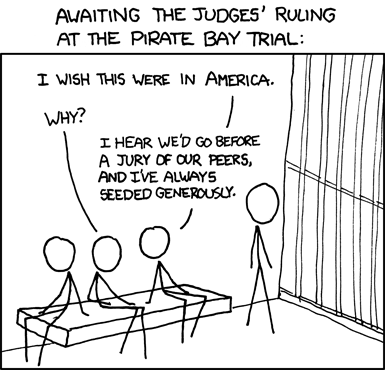
Oh, and I posted my paper on music and games in the generations thread here, if anyone cares

Edited by Christopholofigus, 13 March 2009 - 04:37 AM.
#9
hog
-
- Sponsor
-
- 1,302 posts
official linguist
- Location:Montreal area, QC
- Country:Canada
Posted 13 March 2009 - 04:48 PM
Very well said Roady. 
And nice comic christo.
And nice comic christo.


0 user(s) are reading this topic
0 members, 0 guests, 0 anonymous users

